BS 5266-1:2025 – What Has Changed and What It Means for You as a Client
Emergency lighting is one of those building safety systems that often goes unnoticed, until it is needed most. In the event of a fire, power failure, or emergency evacuation, compliant emergency lighting helps occupants remain calm, locate escape routes, identify firefighting equipment, and exit the building safely.
The release of BS 5266-1:2025 marks the biggest update to UK emergency lighting guidance in nearly a decade, replacing BS 5266-1:2016 with a more comprehensive and performance focused approach.
For building owners, facilities managers, duty holders, and Responsible Persons, these changes are important because they directly affect how emergency lighting systems are designed, maintained, tested, and assessed.
Why Was the Standard Updated?
Modern buildings are becoming increasingly complex. Mixed use developments, healthcare environments, high-occupancy premises, and stay-put evacuation strategies all require emergency lighting systems that do more than simply illuminate an escape route.
The 2025 revision was introduced to:
- Improve life safety
- Align with updated European standards
- Clarify areas that were previously open to interpretation
- Increase system resilience and reliability
- Introduce more measurable compliance standards
The result is a standard that places greater emphasis on real-world performance rather than simple installation compliance.
The Main Changes in BS 5266-1:2025
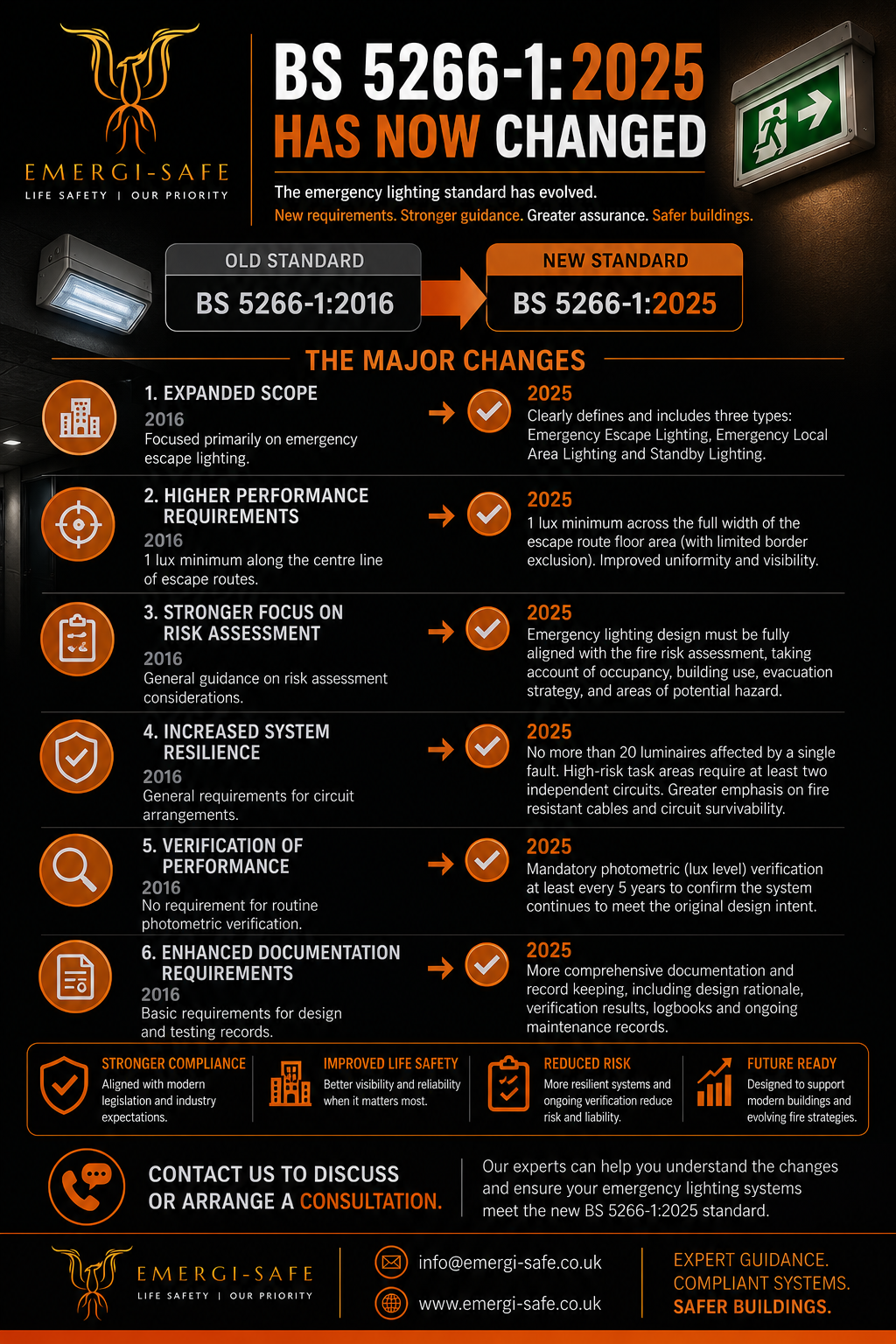
1. Expanded Scope of Emergency Lighting
One of the most significant changes is that the standard now formally recognises three distinct categories of emergency lighting:
Emergency Escape Lighting
Still focused on safe evacuation and escape routes.
Emergency Local Area Lighting
Previously referred to informally as “emergency safety lighting,” this is now formally defined within the standard. It applies to areas where occupants may remain temporarily during a mains failure rather than evacuate immediately.
Standby Lighting
Standby lighting is now fully integrated into the standard instead of being treated separately through risk assessment interpretation.
What This Means for Clients
As a client or building owner, you may now require additional lighting provisions in areas that were previously considered acceptable under older guidance. This is especially relevant in:
- Healthcare facilities
- Care homes
- Large commercial buildings
- Hotels
- Industrial premises
- Buildings with phased evacuation or stay-put strategies
Your emergency lighting design must now consider how occupants behave during different emergency scenarios, not simply how they leave the building.
2. Higher Lighting Performance Requirements
Under the 2016 version, the required 1 lux illumination level primarily applied along the centre line of escape routes.
Under the 2025 revision, the 1 lux minimum now applies across the full width of the escape route floor area, with only a limited border exclusion permitted.
Why This Matters
This creates:
- Better light uniformity
- Fewer dark spots
- Improved visibility during evacuation
- Safer movement for occupants
What This Means for Clients
Many older emergency lighting installations that technically complied under the 2016 standard may no longer achieve the required light levels under the new guidance.
This could mean:
- Additional luminaires
- Repositioning of fittings
- Upgraded emergency lighting designs
- New lux level surveys
3. Stronger Focus on Risk Assessment
BS 5266-1:2025 places greater emphasis on integrating emergency lighting design with the building’s fire risk assessment.
The lighting system must now reflect:
- Occupancy type
- Building use
- Evacuation strategy
- High-risk areas
- Occupant familiarity
- Areas where people may remain during emergencies
What This Means for Clients
Emergency lighting can no longer be viewed as a “fit and forget” system.
Clients are expected to:
- Review whether existing systems remain suitable
- Ensure emergency lighting matches current building use
- Reassess areas affected by refurbishment or layout changes
- Demonstrate that systems remain appropriate during fire risk assessments
4. Increased System Resilience Requirements
The 2025 edition introduces clearer guidance on system reliability and circuit resilience.
Examples include:
- No more than 20 luminaires affected by a single central circuit fault
- High-risk task areas requiring at least two independent circuits
- Greater emphasis on cable fire resistance and circuit survivability
What This Means for Clients
This may impact:
- New installations
- Refurbishment projects
- Central battery systems
- Existing distribution arrangements
Although not every existing installation will require immediate upgrades, future works and risk assessments are likely to reference these new expectations.
5. Mandatory Photometric Verification
One of the most practical changes is the move towards measured performance verification.
The standard now introduces five-year photometric verification requirements to confirm that installed emergency lighting still achieves the original design intent.
This goes beyond simply checking whether fittings illuminate during testing.
What This Means for Clients
Routine monthly and annual testing alone may no longer be enough to demonstrate compliance.
Clients should expect:
- Lux level testing
- Measured performance surveys
- More detailed documentation
- Greater evidence requirements during audits or fire inspections
This is particularly important for ageing LED systems where light output can deteriorate over time despite fittings still operating.
6. Enhanced Documentation Requirements
BS 5266-1:2025 strengthens expectations around:
- Design documentation
- Handover information
- Certification
- Testing records
- Logbooks
- Ongoing verification records
What This Means for Clients
You may now be expected to retain more detailed evidence showing:
- Why the system was designed the way it was
- How compliance was verified
- What testing has been completed
- Whether the system still meets the intended evacuation strategy
This becomes especially important in the event of:
- Fire authority inspections
- Insurance investigations
- Enforcement action
- Liability claims following incidents
Does BS 5266-1:2025 Apply Retrospectively?
Technically, British Standards are not usually retrospective. However, under the Regulatory Reform (Fire Safety) Order 2005, Responsible Persons must ensure fire precautions remain suitable and sufficient.
In practice, this means:
- Existing systems may still be accepted if they remain safe
- Fire risk assessments may identify deficiencies against current standards
- Significant alterations or refurbishments may trigger upgrades
- Older systems may require improvement if risks have changed
The Bigger Picture for Clients
The new standard reflects a wider shift within the fire safety industry:
- From minimum compliance
- Towards demonstrable performance and resilience
Clients should now view emergency lighting as:
- A life safety system
- A legal responsibility
- A documented compliance requirement
- An integral part of fire strategy
The days of simply installing a few bulkheads and carrying out annual discharge tests are rapidly disappearing.
What Should Clients Do Now?
If your premises still operates under older emergency lighting designs, now is the ideal time to:
- Review existing systems
- Conduct lux level surveys
- Reassess fire risk strategies
- Check documentation and logbooks
- Identify non-compliant escape routes
- Plan future upgrades proactively rather than reactively
Early assessment can help avoid:
- Enforcement issues
- Failed audits
- Unsafe evacuation conditions
- Costly emergency remedial works later on
Final Thoughts
BS 5266-1:2025 represents a major evolution in emergency lighting guidance. While many of the core principles remain familiar, the expectations around performance, resilience, verification, and risk-based design have increased significantly.
For clients, the message is clear:
Emergency lighting is no longer just about having fittings installed, it is about proving the system will perform effectively when lives depend on it.