BS 5839-1:2025 – What Has Changed and What It Means for You as the Client
Fire alarm systems are one of the most important life safety systems within any building. Their purpose is simple but critical, to provide early warning of fire so occupants can evacuate safely and emergency procedures can begin quickly.
Over the years, however, buildings have become more complex, evacuation strategies have evolved, and expectations around life safety have increased significantly. Modern premises now rely heavily on interconnected systems, phased evacuation strategies, remote monitoring, and more sophisticated fire detection technologies.
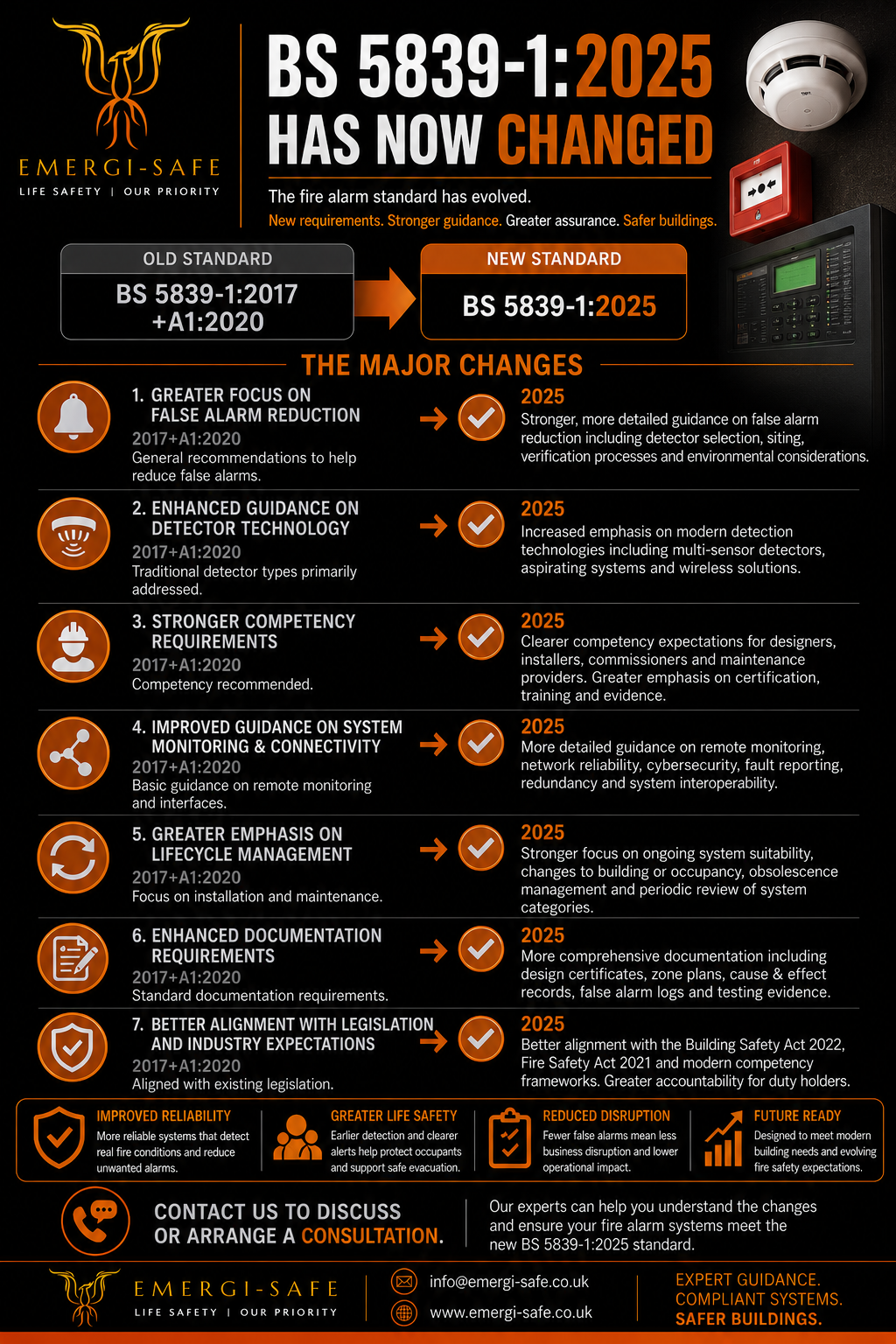
The release of BS 5839-1:2025 reflects these changes and introduces important updates to the UK’s primary fire detection and fire alarm standard for non-domestic premises, replacing BS 5839-1:2017+A1:2020.
For Responsible Persons, building owners, facilities managers, and duty holders, these changes affect not only how fire alarm systems are designed and installed, but also how they are maintained, managed, documented, and integrated into wider fire safety strategies.
Why Was BS 5839-1 Updated?
The updated standard was introduced to address several industry concerns, including:
- Increasing reliance on complex building evacuation strategies
- Poor maintenance practices
- False alarm management
- Growing use of wireless and networked technologies
- Better integration with other fire safety systems
- Lessons learned from major fire incidents
- Alignment with modern legislation and competency expectations
The 2025 revision places far greater emphasis on system reliability, verification, competency, and lifecycle management rather than simply achieving minimum installation compliance.
The Main Changes in BS 5839-1:2025
1. Greater Focus on False Alarm Reduction
False alarms continue to be one of the largest problems affecting fire alarm systems across the UK.
They can lead to:
- Occupant complacency
- Business disruption
- Unnecessary fire service attendance
- Financial penalties
- Reduced confidence in fire safety systems
BS 5839-1:2025 introduces stronger recommendations surrounding false alarm management, particularly in relation to:
- Detector selection
- Detector siting
- Multi-sensor technology
- Alarm verification procedures
- Environmental considerations
What This Means for Clients
Clients should now expect more detailed consideration of:
- The building environment
- Sources of steam, dust, fumes, and aerosols
- Occupant behaviour
- Operational processes
This may influence:
- Detector types specified
- Device locations
- Cause-and-effect programming
- Future maintenance requirements
The aim is not simply to “detect fire,” but to detect real fire conditions while reducing unwanted alarms.
2. Enhanced Guidance on Detector Technology
The new standard places greater emphasis on modern detection technologies, particularly:
- Multi-sensor detectors
- Intelligent addressable systems
- Aspirating smoke detection
- Wireless detection systems
The guidance recognises that traditional point smoke detectors are not always the best solution for every environment.
What This Means for Clients
Clients may now see more advanced technologies recommended during:
- New installations
- System upgrades
- Fire risk assessments
- Refurbishment projects
Although these technologies may carry higher initial costs, they often provide:
- Better reliability
- Earlier detection
- Reduced false alarms
- Lower long-term disruption costs
3. Stronger Competency Requirements
One of the biggest themes throughout BS 5839-1:2025 is competency.
The standard now places much greater emphasis on ensuring that:
- Designers are competent
- Installers are competent
- Commissioners are competent
- Maintenance providers are competent
There is clearer guidance surrounding:
- Third-party certification
- Evidence of training
- System documentation
- Verification procedures
What This Means for Clients
Choosing contractors based purely on price is becoming increasingly risky.
Clients should now place greater importance on:
- Accredited providers
- Third-party certification
- Proven competency
- Detailed commissioning records
- Ongoing service capability
This is particularly important because fire alarm systems are now more technically complex than ever before.
4. Improved Guidance on System Monitoring and Connectivity
The 2025 revision reflects the increasing use of:
- Remote monitoring
- Cloud-connected systems
- Networked panels
- Off-site alarm receiving centres
- Integrated building management systems
The standard introduces clearer expectations around:
- Signal reliability
- Fault monitoring
- Communication integrity
- Redundancy arrangements
What This Means for Clients
If your building relies on monitored alarm systems, clients may now need to consider:
- Communication path resilience
- Network security
- Monitoring reliability
- Backup arrangements
- Fault reporting procedures
This is especially important in:
- High-risk premises
- Residential buildings
- Healthcare environments
- Large commercial properties
5. Greater Emphasis on Lifecycle Management
Historically, some organisations viewed fire alarm compliance as simply:
- Install the system
- Test it periodically
- Repair faults when required
BS 5839-1:2025 introduces a much broader lifecycle approach.
The standard now places stronger emphasis on:
- Ongoing system suitability
- Building changes
- Occupancy changes
- Device ageing
- Obsolescence management
- Record keeping
- Periodic review of system categories
What This Means for Clients
Clients are now expected to consider whether systems remain appropriate over time, not simply operational.
For example:
- Has the building layout changed?
- Have occupancy levels increased?
- Are detectors becoming obsolete?
- Is the evacuation strategy still suitable?
- Does the existing system still meet the fire risk assessment?
This moves fire alarm compliance away from “maintenance only” and towards active system management.
6. Enhanced Documentation Requirements
BS 5839-1:2025 significantly strengthens expectations around documentation and traceability.
This includes:
- Design certificates
- Zone plans
- Cause-and-effect documentation
- Variations from the standard
- Maintenance records
- False alarm logs
- Testing evidence
Why This Matters
Documentation is now seen as a critical part of demonstrating compliance and due diligence.
What This Means for Clients
Clients should expect:
- More comprehensive handover packs
- Better service reporting
- Detailed logbooks
- Greater evidence requirements during audits or fire inspections
Poor documentation is increasingly viewed as a compliance failure in its own right.
7. Better Integration with Modern Fire Safety Legislation
The revised standard aligns more closely with:
- The Building Safety Act 2022
- The Fire Safety Act 2021
- The Regulatory Reform (Fire Safety) Order 2005
- Competency frameworks within the fire industry
What This Means for Clients
Responsible Persons now face greater scrutiny regarding:
- System suitability
- Maintenance standards
- Contractor competency
- Record keeping
- Fire strategy integration
This is especially relevant within:
- Higher-risk residential buildings
- Healthcare
- Education
- Hospitality
- Commercial premises
Does BS 5839-1:2025 Apply Retrospectively?
Like most British Standards, BS 5839-1:2025 is not automatically retrospective.
However, under fire safety legislation, fire alarm systems must remain:
- Suitable
- Sufficient
- Properly maintained
- Appropriate to current risks
In practice, this means:
- Existing systems may still require upgrades if deficiencies are identified
- Fire risk assessments may reference current guidance
- Refurbishments may trigger compliance reviews
- Older systems may become difficult to justify if they no longer reflect modern risks
The Bigger Picture for Clients
BS 5839-1:2025 reflects a major shift in fire safety philosophy:
- Away from basic installation compliance
- Towards demonstrable system performance, reliability, and management
For clients, this means fire alarm systems should now be viewed as:
- Active life safety systems
- Continuously managed assets
- Part of the overall building fire strategy
- Systems requiring evidence-based compliance
The focus is no longer simply:
“Does the alarm work?”
The focus is now:
“Will the system reliably detect fire, support evacuation, minimise disruption, and remain suitable throughout the building lifecycle?”
What Should Clients Do Now?
If your premises still operates under older fire alarm arrangements, now is the ideal time to:
- Review existing system categories
- Assess false alarm history
- Check documentation and zone plans
- Verify contractor competency
- Review monitoring arrangements
- Consider detector suitability
- Reassess building changes and occupancy risks
- Plan future upgrades proactively
Early assessment can help avoid:
- Enforcement action
- Excessive false alarms
- System failures
- Costly emergency upgrades
- Business disruption
- Insurance concerns
Final Thoughts
BS 5839-1:2025 represents one of the most important updates to UK fire alarm guidance in recent years.
The standard makes it clear that modern fire alarm systems must do far more than simply sound an alarm. They must:
- Detect accurately
- Operate reliably
- Integrate with building strategies
- Minimise unwanted alarms
- Remain suitable throughout the building lifecycle
For clients, the message is straightforward:
Fire alarm compliance is no longer just about installation, it is about proving that the entire system will perform effectively when lives depend on it.